
US Vice-President JD Vance Arrives in Hungary to Back Orbán's Critical Re-election Bid
US Vice-President JD Vance has arrived in Budapest to publicly endorse Hungarian Prime Minister Viktor Orbán ahead of hotly contested parliamentary elections scheduled for this Sunday. The visit underscores the robust alliance between the Trump administration and Orbán's government, as the long-serving Hungarian leader faces what is widely considered his most significant electoral challenge in decades.
Vance is slated to participate in a joint press conference and will address an election rally alongside Orbán in a football stadium later today. This high-profile support aims to bolster Orbán's campaign in a critical election.
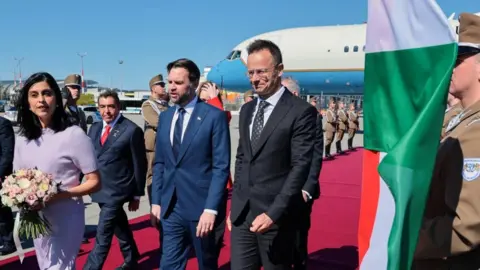
Vance's High-Profile Show of Support
Upon arrival, Vice-President Vance and his wife, Usha, were greeted by Hungarian Foreign Minister Péter Szijjártó. Szijjártó lauded the friendship between Orbán and President Donald Trump, describing it to Hungarian media as inaugurating a "new golden age" in their bilateral relations. President Trump himself offered his "complete and total support" for Orbán last month in a video message to the Hungarian Conservative Political Action Conference (CPAC).
"I'm looking forward to seeing my good friend Viktor, and we'll talk about any number of things related to the US-Hungary relationship," Vance told reporters earlier as he departed Washington. Orbán's government hopes Vance's presence will persuade undecided Hungarian voters, portraying the Prime Minister as a strong and internationally respected leader during turbulent global times.
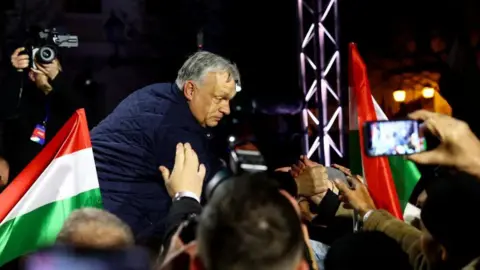
The Approaching Election and Orbán's Challenger
The April 12 election is being touted as Orbán's toughest contest in a political career spanning almost 40 years, during which he has secured four consecutive victories since 2010. He faces Péter Magyar, a former Fidesz insider who departed from the prime minister two years ago to establish the centre-right Tisza party.
Most opinion polls indicate Tisza leading Fidesz by a margin of 10% to 20%, with only the strongly pro-government Nézőpont agency placing Fidesz narrowly ahead. The outcome hinges on Orbán's ability to consolidate support against a formidable new challenger.
Deepening US-Hungary Ties Under Trump
Orbán has cultivated strong ties with the US MAGA movement backing former American President Donald Trump. Their friendship dates back to 2016, when Orbán was the first and only EU leader to publicly support Trump in the US presidential election. Orbán was a strong backer of Trump's 2024 re-election bid and visited Washington last October to secure an exemption for Hungary from US sanctions targeting Russian oil giants Rosneft and Lukoil.
Trump later clarified that this exemption was a personal agreement between him and Orbán, suggesting that a successor to Orbán might need to re-apply. Hungary has also committed to increasing its purchases of US liquefied natural gas (LNG), as well as American nuclear technology and fuel, diversifying its energy portfolio.
Energy Security Concerns Amidst Geopolitical Tensions
Hungary, almost uniquely among EU countries, has resisted calls from Brussels to reduce its reliance on Russian fossil fuels. It heavily depends on Russian oil via the Druzhba pipeline, which traverses Ukraine, and Russian gas through the TurkStream pipeline from the south. Both supply routes are currently facing issues.
The Druzhba pipeline has not delivered oil to Hungary since late January, with Orbán attributing the disruption to Ukraine's failure to restore it after a Russian attack on oil infrastructure. More recently, the Serbian government announced the neutralization of explosives near the TurkStream gas pipeline, an incident Orbán and pro-government media swiftly labeled a "terror attack" on Hungary's energy supply. However, former intelligence sources and opposition leader Péter Magyar have accused Orbán of potentially staging the incident with Serbian President Aleksandar Vučić to boost his re-election chances. The Trump administration has offered no visible diplomatic support to Hungary regarding the Druzhba pipeline issue.
Domestic Scandals and Eroding Popularity
Orbán has made hostility towards Ukraine and its president, Volodymyr Zelensky, a central theme of his election campaign. However, his popularity has also been affected by recent scandals. Private telephone conversations between Foreign Minister Szijjártó and senior Russian officials were leaked, with transcripts suggesting Szijjártó regularly informed the Russian government about confidential discussions at European Union summits and lobbied for Russian officials to be removed from sanctions lists. Szijjártó has defended these interactions as "normal diplomacy."
The alignment between Prime Minister Orbán and former President Trump highlights a growing trend of populist leaders fostering international alliances that often bypass traditional diplomatic norms. For Olley News readers, this demonstrates the intricate web of global political support systems influencing national elections, particularly as a nation navigates complex energy dependencies and internal political challenges.
Key Takeaways
- US Vice-President JD Vance is in Hungary to endorse Prime Minister Viktor Orbán ahead of critical parliamentary elections.
- The April 12 election is seen as Orbán's toughest challenge in decades, as he faces former Fidesz insider Péter Magyar.
- Orbán's close relationship with Donald Trump has provided significant political and economic benefits, including exemptions from Russian oil sanctions.
- Hungary confronts pressing energy security challenges due to disruptions in Russian oil and gas pipelines, alongside allegations of a staged pipeline incident.
- Recent leaks regarding Foreign Minister Szijjártó's communications with Russian officials have contributed to a decline in Orbán's public standing.


0 Comments