
Daring US Mission Rescues Airman from Iran, Amid Claims of Destroyed Aircraft
A high-stakes US special forces operation successfully extracted an injured airman from a remote mountainous region in Iran on Sunday, two days after his F-15E Strike Eagle jet was shot down. The complex rescue unfolded against a backdrop of advancing Iranian operatives and has resulted in conflicting reports regarding the destruction of multiple US aircraft.
Images Emerge of Alleged Wreckage
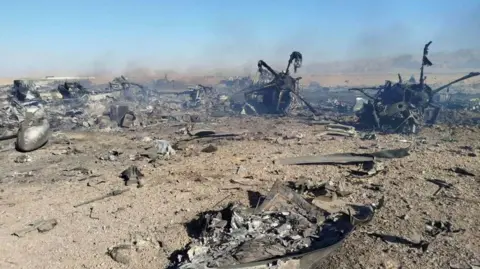
Iranian state television has broadcast images purporting to show the burned wreckage of aircraft claimed to be destroyed during the US rescue mission. The debris, showing what appears to be two propellers among scraps of metal and smoke on sandy ground, is presented by Iran as evidence of US losses.
The Stranding and Initial Search Efforts
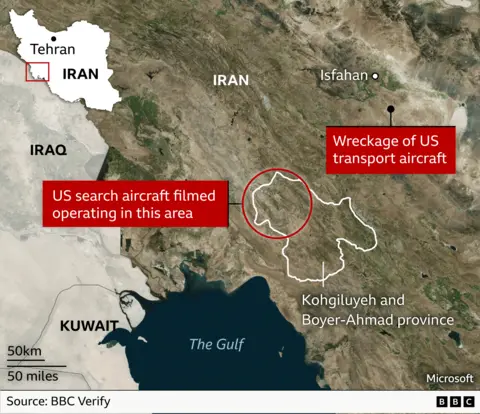
The airman's ordeal began on Friday when an F-15E Strike Eagle was shot down over southwestern Iran, marking the first such incident in over two decades. While the pilot was rescued the same day, the second crew member, a weapons operator, became separated and remained stranded in a sparsely populated, rugged region.
As US aircraft were seen flying low over the area on Saturday, Iran offered a bounty of £50,000 ($66,100) for the airman's capture. Unverified videos shared on social media appeared to show armed civilians participating in the search.
Covert Intelligence and Deception Campaign
Armed with a handgun and trained for survival, the airman reportedly hid in a mountain crevice, restricting the use of his beacon signal to avoid detection by Iranian forces. US officials indicated his location was monitored "24 hours a day" by the CIA, which also had to rule out the possibility of an Iranian trap.
The CIA reportedly conducted a deception campaign within Iran, falsely spreading word that US forces had already located the airman, a tactic aimed at misdirecting Iranian efforts.
The Rescue Operation Commences
As US special forces aboard several aircraft made their way towards the stranded officer, strikes were reportedly launched to keep Iranian troops away from the area. The airman, from his hiding place high on a 7,000ft ridge, communicated information on Iranian positions to aid these strikes.
Highly trained Navy SEALs were subsequently airdropped in to recover the injured airman.
Logistical Challenges and Aircraft Destruction
The extraction faced significant hurdles when two C-130 transport planes, tasked with retrieving rescue crews, became bogged down in soil and were unable to take off from the remote base in Iran they had used. US officials confirmed the planes were destroyed to prevent them from falling into enemy hands, a standard military practice.

Conflicting Accounts and Aftermath
Iran's military stated that two US C-130 military transport planes and two Black Hawk helicopters were destroyed during the operation, claiming a "deception and escape mission at an abandoned airport in southern Isfahan…was completely foiled." Iranian state media also reported shooting down a US drone. US officials, however, have denied that their forces came under attack.
US special forces ultimately left Iran on three extra aircraft sent to collect the crews, utilizing a rudimentary airfield. The rescued airman landed in Kuwait for medical treatment. President Trump said he was "seriously wounded" but "will be just fine."
Olley News Insight: The successful extraction of the airman highlights the US military's unwavering commitment to its personnel, even at considerable risk and cost. However, the destruction of multiple aircraft and conflicting narratives underscore the complex and dangerous nature of operations within hostile territories, potentially escalating regional tensions.
International Support and Strategic Perspectives
An Israeli intelligence official reportedly told the Jerusalem Post that the IDF assisted with the operation, including launching strikes "designed to act as a diversion, drawing Iranian security forces away from the crash site and toward other areas."
While Iranian officials have characterized the operation as a failure, some US analysts acknowledge the loss of aircraft but emphasize the paramount importance of the "no one left behind" military tradition. Gen Frank McKenzie, former commander of US Central Command, stated, "It takes a year to build an aircraft - it takes 200 years to build a military tradition where you don't leave anybody behind."
Key Takeaways
- A US F-15E Strike Eagle jet was shot down over southwestern Iran on Friday.
- One US airman was left stranded for two days in a remote, mountainous region.
- US special forces, including Navy SEALs, conducted a high-stakes rescue mission into Iran.
- The airman's location was monitored by the CIA, which also reportedly ran a deception campaign.
- Two US C-130 transport planes became bogged down and were destroyed to prevent them from falling into enemy hands.
- Iran claims additional aircraft were destroyed and its forces foiled the mission, which US officials deny.
- Israel's IDF reportedly assisted with diversionary strikes.
- The rescued airman, described as "seriously wounded," is receiving medical treatment in Kuwait.


0 Comments