
Min Aung Hlaing Becomes Myanmar President Amidst Civil War and Economic Crisis
Myanmar's military leader, General Min Aung Hlaing, has been elected president by a newly formed parliament, five years after orchestrating a coup that plunged the nation into a brutal civil war. The move, seen by many as a carefully orchestrated "coronation," solidifies military control over the country, despite his earlier promise of a swift return to civilian rule.
A Preordained Presidency
The election of Min Aung Hlaing, who has stepped down as armed forces commander, comes after a parliamentary vote described by observers as a formality. The new parliament is dominated by his loyalists, with the military guaranteed a quarter of seats and the military-backed Union Solidarity and Development Party (USDP) securing nearly 80% of the remaining seats in what critics label a heavily biased election.
To ensure his continued authority, Min Aung Hlaing has appointed General Ye Win Oo, a known hardliner, as his successor in the armed forces and established a new consultative council to oversee both civilian and military affairs.
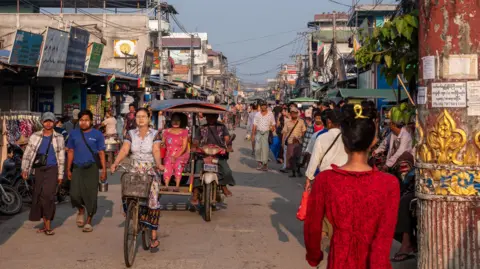
A busy street in a market in Yangon, where daily life continues amidst ongoing challenges. Credit: Jonathan Head/BBC
Five Years of Catastrophe
The five years since the February 2021 coup, which deposed Aung San Suu Kyi's elected government, have been devastating for Myanmar. Min Aung Hlaing's decision to use lethal force against widespread protests ignited a civil war that has claimed thousands of lives, displaced millions, and crippled the economy. The military regime has lost control of significant territory to armed resistance groups, responding with indiscriminate air attacks on opposition-held villages, a tactic historically known as "the four cuts."
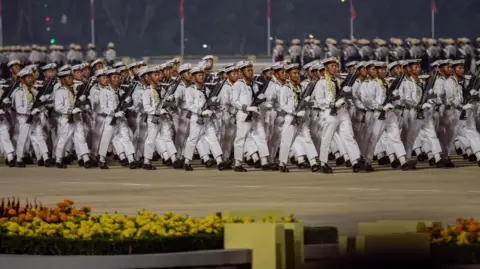
Myanmar's junta holds an annual military parade in the capital Nay Pyi Taw, even as civil war rages across the country. Credit: Jonathan Head/BBC
Unwavering Stance and Continued Conflict
Despite the widespread destruction, Min Aung Hlaing's recent speech at the annual armed forces parade offered no hint of regret. He reiterated familiar justifications for military intervention and labeled opponents as "armed terrorist factions" backed by "foreign aggressors." Analysts, such as Su Mon of ACLED, predict that the conflict will largely remain unchanged, with the new commander-in-chief expected to continue aggressive campaigns to regain lost territory, leading to more air strikes and "scorched earth" tactics against civilians.
The National Unity Government (NUG), representing the overthrown administration, has declared the new government illegitimate and vows to continue fighting for a military-free political life and a new federal constitution.
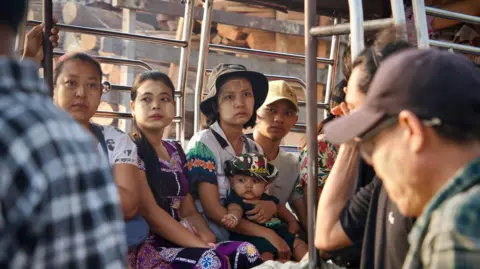
After five years of relentless conflict, Myanmar's populace remains exhausted and uncertain about their future. Credit: Lulu Luo/BBC
Deepening Economic Hardship
The conflict has severely impacted Myanmar's economy, with the UN estimating over 16 million people in need of humanitarian assistance and nearly four million displaced. Runaway inflation and recent fuel shortages, exacerbated by global events and import restrictions, have further collapsed living standards. Motorbike taxi driver Tin Oo from Yangon encapsulates the daily struggle: "We cannot earn enough even to cover our rent and food." Businesses heavily reliant on generators also suffer from unreliable electricity and high fuel costs.
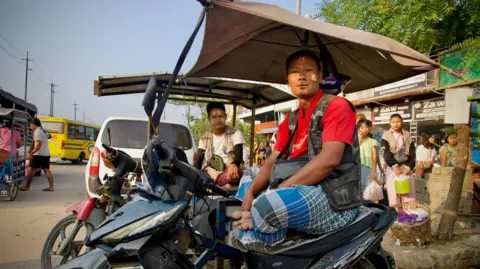
Tin Oo, a motorbike taxi driver in Yangon, highlights the immense struggle of everyday life in Myanmar's current climate. Credit: Lulu Luo/BBC
A Narrow Path to Peace
In a rare call for de-escalation, veteran activist Mya Aye has formed a new council advocating for dialogue between the military and its opponents, and the release of political prisoners, including Aung San Suu Kyi. He argues that the current election is merely a "game played by Min Aung Hlaing," and the country is on the brink of collapse. While there is speculation about Suu Kyi's potential release this year, the military rulers show little inclination towards compromise, making the path to peace exceedingly narrow.
Key Takeaways
- General Min Aung Hlaing, Myanmar's coup leader, has been elected president by a military-dominated parliament.
- The election is widely regarded as a "coronation" solidifying military power, five years after his coup.
- The coup initiated a brutal civil war, displacing millions and severely damaging the economy.
- Min Aung Hlaing remains unapologetic, and the new military leadership is expected to continue aggressive tactics.
- Economic hardship, including rampant inflation and critical fuel shortages, is widespread across the country.
- A veteran activist advocates for dialogue and the release of political prisoners, including Aung San Suu Kyi, as a possible route to peace.
Olley News Insight: The transition of General Min Aung Hlaing from military commander to president, while seemingly a move towards 'civilian rule,' is largely symbolic. His careful structuring of the new government and military leadership ensures continued authoritarian control. The international community, already critical of the regime, will likely see this as a further entrenchment of military power rather than a genuine step towards democracy, compounding the ongoing humanitarian and economic crises.


0 Comments