
Artemis II Astronauts Break Earth Orbit, Charting Historic Course for Lunar Flyby
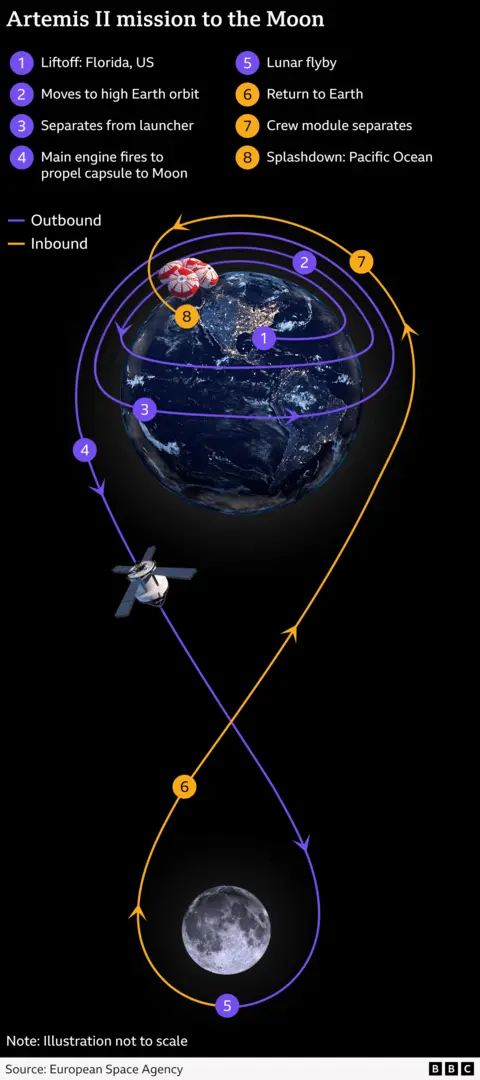
The four-member crew of NASA's Artemis II mission has successfully departed Earth's orbit, executing a critical engine burn that propels their Orion spacecraft towards a looping journey around the far side of the Moon. This landmark event marks the first time humans have ventured beyond Earth's immediate orbital sphere since 1972, ushering in a new era of lunar exploration.
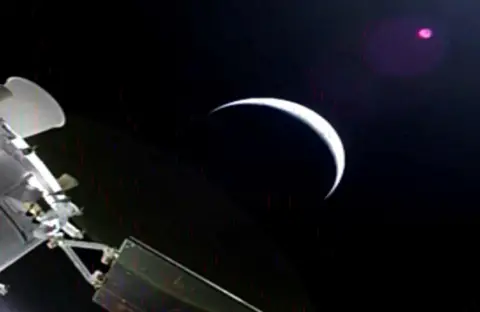
Critical Engine Burn Propels Orion Towards Moon
The pivotal five-minute and 55-second translunar injection (TLI) engine burn, crucial for escaping Earth's gravitational pull, was completed "flawlessly," according to Dr. Lori Glaze of NASA. Speaking from the Orion capsule, Canadian astronaut Jeremy Hansen conveyed the crew's high spirits, stating they were "feeling pretty good up here on our way to the Moon."
Pioneering Deep Space Travel and Record-Breaking Trajectory
Artemis II is now on a trajectory that will carry its crew further into space than any humans before them, an estimated 4,700 miles (7,600 km) beyond the Moon, potentially surpassing the distance record set by Apollo 13 in 1970. Astronaut Hansen emphasized the collective effort behind this achievement, noting, "Humanity has once again shown what we are capable of. It's your hopes for the future that carry us now on this journey around the Moon."
Olley News Insight Box
The translunar injection (TLI) is a crucial maneuver in crewed lunar missions. It's a high-thrust burn that accelerates the spacecraft to escape velocity, setting it on a precise path to intercept the Moon's gravitational field. A flawless TLI is vital for mission success, dictating the trajectory, fuel consumption, and safety parameters for the entire lunar transit.
Astronauts Share Awe-Inspiring Views and Anticipate Celestial Event
Commander Reid Wiseman described the "spectacular view" afforded as the spacecraft moved away from Earth, revealing the "entire globe from pole to pole." The crew has been "glued to the window" as Earth shrinks and the Moon grows in their view. Around the sixth day of the mission, the astronauts are set to witness a rare total solar eclipse as the Moon passes directly in front of the Sun.
Robust Safety Protocols Underpin Historic Journey
Despite the deep space trajectory, the TLI burn is not a "point of no return" for Orion. Mission controllers maintain the capability to execute an emergency return to Earth within the first 36 hours. Orion program manager Howard Hu confirmed that hundreds of thousands of simulations have been run to ensure crew safety, expressing his satisfaction after the successful burn by saying, "What a great couple of days!"

Key Takeaways
- Artemis II successfully completed its translunar injection (TLI) engine burn.
- The Orion spacecraft is now on a path to loop the far side of the Moon.
- This is the first human mission beyond Earth orbit since 1972.
- The mission aims to travel further from Earth than any previous human spaceflight.
- Astronauts are in good spirits and captivated by changing views of Earth and the Moon.
- Robust safety protocols are in place for potential emergency returns.
- The crew will observe a total solar eclipse from space around day six of the mission.


0 Comments