
Artemis II Blasts Beyond Earth's Orbit Towards Lunar Far Side
Olley – The four-member crew of Nasa's Artemis II mission has successfully departed Earth's orbit, embarking on a historic journey that will take humans further into space than ever before. Following a flawless engine burn, their Orion spacecraft is now on a trajectory to loop around the far side of the Moon.
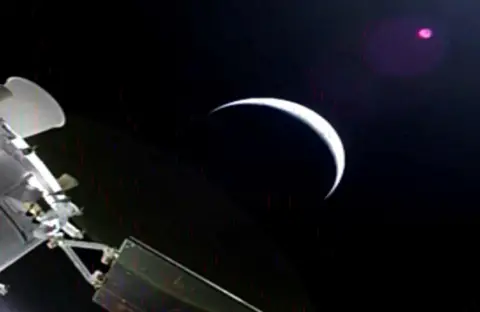
Successful Trans-Lunar Injection Propels Orion
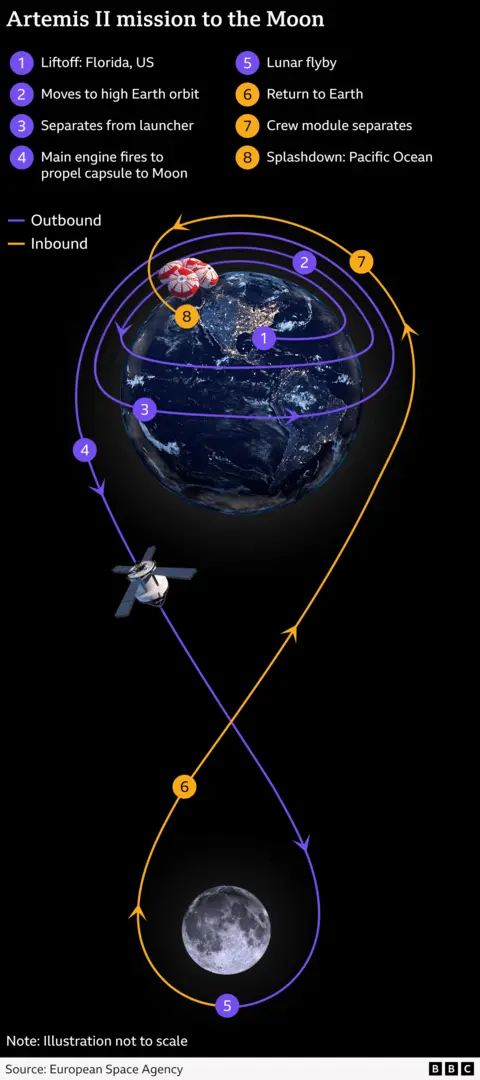
The critical five-minute and 55-second main engine firing, known as the translunar injection (TLI), was executed perfectly, according to Nasa's Dr. Lori Glaze. This pivotal maneuver accelerated the Orion capsule, sending it onto a looping path that will carry the crew around the Moon.
Canadian astronaut Jeremy Hansen, speaking from Orion, expressed the crew's positive spirits, remarking, "We're feeling pretty good up here on our way to the Moon." He added a powerful sentiment: "Humanity has once again shown what we are capable of. It's your hopes for the future that carry us now on this journey around the Moon."
A Journey Beyond Previous Human Frontiers
Artemis II marks the first time humans have traveled beyond Earth's orbit since the Apollo 17 mission in 1972. The mission is designed to push the boundaries of human space exploration, propelling the crew more than 4,700 miles (7,600 km) beyond the Moon.
This distance is expected to surpass the record set by Apollo 13 in 1970, depending on the precise timing and trajectory. The ambitious journey will see the Earth gradually diminish in size as Orion ventures deeper into space.
Rigorous Preparations and Safety Protocols
Before the TLI, the crew spent approximately a day in a "high Earth orbit," during which Orion's engines, navigation, and life-support systems underwent thorough checks. Only after final approval was granted did the decisive engine burn commence.
Nasa officials emphasize that the TLI is not a "point of no return." Mission controllers maintain the ability to initiate an emergency return to Earth if necessary. Orion programme manager Howard Hu confirmed that hundreds of thousands of simulations have been conducted "to ensure that we are able to get the crew home safely."

Spectacular Views Await Astronauts
As Orion surges into deep space, the astronauts are anticipated to witness awe-inspiring celestial phenomena. The Earth will shrink to a distant "blue and white marble," while the Moon will grow to fill their view as a heavily cratered world.
A highlight of the mission is expected on about the sixth day, when the crew will experience a total solar eclipse as the Moon passes directly in front of the Sun, revealing its shimmering corona, with Earth visible in the distance.
Key Takeaways
- Artemis II crew successfully executed the translunar injection (TLI) burn, leaving Earth's orbit for the Moon.
- This is the first human spaceflight beyond Earth orbit since 1972.
- The mission aims to take astronauts over 4,700 miles beyond the Moon, potentially setting a new distance record.
- Astronaut Jeremy Hansen conveyed the crew's excitement and highlighted humanity's collective achievement.
- Safety protocols include the ability for emergency return maneuvers, backed by extensive simulations.
- The crew will observe Earth shrinking, the Moon growing, and a total solar eclipse during their journey.
- The mission is a crucial step towards future lunar landings and deeper space exploration.
Olley News Insight: The Artemis II mission represents a monumental leap in human space exploration, re-establishing humanity's presence beyond low Earth orbit. Its success is not just about breaking distance records, but about validating critical technologies and procedures necessary for long-duration deep space travel, paving the way for future lunar landings and, eventually, missions to Mars.


0 Comments