
Artemis II Propels Humans Deeper into Space, Circling Moon's Far Side
The four astronauts aboard NASA's Artemis II mission have successfully departed Earth's orbit, as their Orion spacecraft executed a flawless translunar injection (TLI) engine burn, setting a course for a historic journey around the far side of the Moon. This marks the first time humans have ventured beyond Earth's orbit since 1972.
Journey to the Moon's Far Side Underway
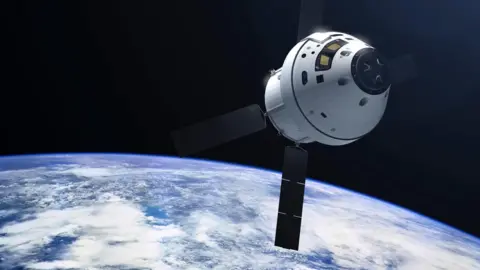
Following a crucial five-minute and 55-second engine firing, known as the translunar injection (TLI), the Orion spacecraft achieved its desired trajectory. NASA's Dr. Lori Glaze confirmed the maneuver went "flawlessly," propelling the crew further into deep space.
From inside the Orion capsule, Canadian astronaut Jeremy Hansen conveyed the crew's positive spirits, stating they were "feeling pretty good up here on our way to the Moon." Humanity has now taken a significant step toward renewed lunar exploration.
A Historic Milestone for Humanity
Artemis II is now on a looping path that will carry the crew around the far side of the Moon and back, marking the first time in over five decades that humans have traveled outside of Earth's direct orbit. The shrinking Earth, visible on the livestream from Orion, serves as a poignant reminder of their expanding distance from home.
Astronaut Hansen, the first non-American to journey to the Moon, acknowledged the collective effort behind the mission. He told Nasa's mission control, "Humanity has once again shown what we are capable of. It's your hopes for the future that carry us now on this journey around the Moon."
Mission Trajectory and Safety Protocols
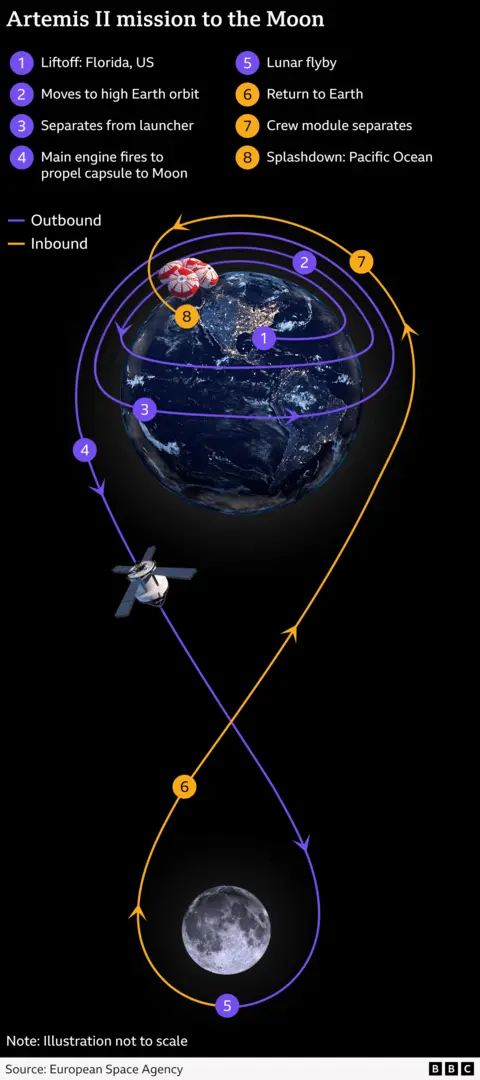
The TLI propelled Orion on a trajectory designed to carry the crew further from Earth than any humans have been before – an estimated 4,700 miles (7,600 km) beyond the Moon. This could potentially surpass the distance record set by Apollo 13 in 1970, depending on precise timing and trajectory details.
Despite the significant push, TLI does not represent a "point of no return." Mission controllers retain the ability to initiate an emergency U-turn to bring the crew back to Earth within the first 36 hours if needed. Beyond that window, continuing around the Moon and returning to Earth can often be a quicker and simpler alternative. Orion programme manager Howard Hu affirmed the team has "run hundreds of thousands of [simulations] to ensure that we are able to get the crew home safely."
Olley News Insight: The translunar injection (TLI) is a critical maneuver that shifts a spacecraft from an Earth-centric orbit onto a trajectory towards the Moon or other celestial bodies. It requires immense precision and power, acting as the definitive "push" that initiates a true deep-space journey.
Unprecedented Views and a Lunar Eclipse
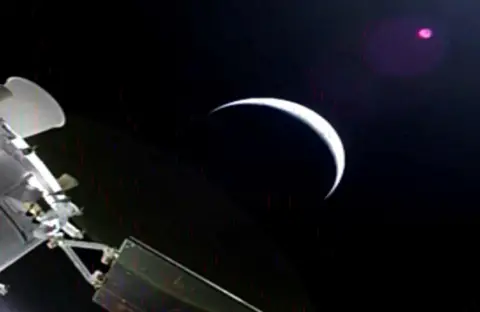
As Orion surges into deep space, the crew will be treated to increasingly awe-inspiring vistas. Earth will shrink to a vibrant blue and white marble, while the Moon will grow from a distant disc into a heavily cratered world filling their view.
Approximately on the sixth day of the mission, as Orion passes beyond the Moon, the astronauts are anticipated to witness a total solar eclipse. The Moon will align perfectly with the Sun, obscuring its bright face and revealing its ethereal shimmering corona, with Earth visible off to one side.
Key Takeaways
- Artemis II's Orion spacecraft successfully completed its translunar injection (TLI) engine burn, sending it toward the Moon.
- This mission marks the first time humans have traveled beyond Earth's orbit since Apollo 17 in 1972.
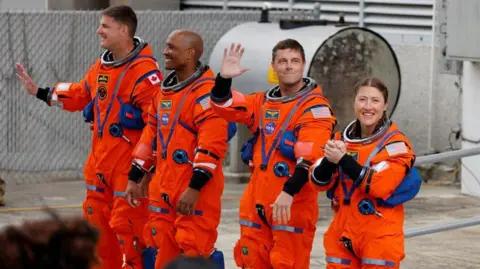
- The four-person crew includes Canadian astronaut Jeremy Hansen, the first non-American to embark on a lunar journey.
- Orion is projected to travel over 4,700 miles (7,600 km) beyond the Moon, potentially setting a new human distance record.
- Despite the deep space trajectory, mission control maintains emergency return protocols.
- Astronauts are expected to witness a total solar eclipse during their journey around the Moon.


0 Comments