
Lapid Warns Israeli Military "Stretched Beyond Limit" Amid Multi-Front War
Israel's main opposition leader, Yair Lapid, has issued a stark warning that the country's military is severely overextended by ongoing conflicts with Iran and Hezbollah in Lebanon, accusing the government of steering the nation towards a "security disaster."
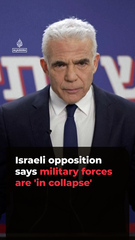
Opposition Leader Voices Grave Concerns
In a video address late Thursday, Lapid declared the military "is stretched to the limit and beyond," echoing private warnings reportedly delivered a day earlier by military chief Eyal Zamir during a security cabinet meeting. Lapid, a centrist figure, criticized the government for deploying the army into a multi-front conflict "without a strategy, without the necessary means, and with far too few soldiers."
Despite his frequent criticisms of the government's war management, Lapid has consistently supported Israel's military campaigns across Gaza, Iran, and Lebanon. Last month, he articulated a vision for Israeli territorial expansion extending to Iraq, founded on Zionist and biblical principles.
Olley News Insight: Yair Lapid's dual stance – supporting military operations while simultaneously criticizing the government's execution – highlights a deep division within Israeli politics regarding the long-term strategy and sustainability of current military engagements, even as a broader consensus on territorial expansion is revealed.
Escalation in Lebanon and Border Buffer Zone Plans
Military spokesman Effie Defrin announced on Thursday that "more combat soldiers are needed" to establish a "defensive" buffer zone within Lebanon. This declaration follows Israel's stated intention to take control of south Lebanon up to the Litani River, approximately 30km (19 miles) from the border, prompting Lebanon to announce it would complain to the United Nations Security Council over Israeli attacks, deeming them a threat to its sovereignty.
Al Jazeera's Nida Ibrahim, reporting from Ramallah, noted that many military analysts and Israeli opposition figures view the buffer zone plan as potentially "very costly." Her report highlighted recent casualties, including two Israeli soldiers killed inside southern Lebanon amidst ongoing clashes with Hezbollah, and one civilian fatality in Israel from an antitank missile fired from Lebanon. This has led many Israelis to question the effectiveness of the current government's and military leadership's strategy.

Regional Conflicts Intensify with Mounting Casualties
The Israeli army has heavily bombarded Lebanon with air attacks and launched a ground offensive in its southern parts since March 2, in response to a cross-border attack by Hezbollah following the killing of Iran's Supreme Leader Ayatollah Ali Khamenei. Hezbollah had previously observed a November 2024 ceasefire but reported launching rockets at northern Israel on Friday, triggering air raid sirens and prompting residents to seek shelter.

United States-Israeli attacks on Iran since February 28 have resulted in nearly 2,000 fatalities. Concurrently, Iranian attacks on Israel have claimed at least 19 lives and wounded over 5,229 people.
Continued Israeli Operations in Gaza Strip
Despite an October 2025 "ceasefire," Israeli forces persist with near-daily attacks in the war-devastated Gaza Strip. These ongoing operations have killed more than 700 Palestinians since the ceasefire, while maintaining severe restrictions on the entry of humanitarian aid and other essential goods into the enclave, deepening its health crisis.
Key Takeaways
- Yair Lapid warns the Israeli military is "stretched to the limit and beyond" by multi-front conflicts.
- Lapid criticizes the government's lack of strategy and resources for the ongoing wars.
- Israel plans a "defensive" buffer zone up to the Litani River in south Lebanon, which is seen as potentially costly.
- Recent clashes in Lebanon have resulted in casualties for both Israeli soldiers and civilians.
- US-Israeli attacks on Iran have killed nearly 2,000, while Iranian attacks on Israel have caused 19 deaths and over 5,200 injuries.
- Israeli forces continue daily attacks in Gaza, killing over 700 Palestinians since the October 2025 ceasefire and restricting aid.


0 Comments