
Global Energy Markets Rocked as Middle East Strikes Send Prices Soaring
Global energy markets have been thrown into turmoil after a series of fresh strikes targeted key energy infrastructure in the Middle East, including Qatar's primary gas facility and Iran's crucial South Pars field. The escalating conflict has led to sharp increases in oil and gas prices, sparking concerns over long-term global supply disruptions and rattling stock markets worldwide.
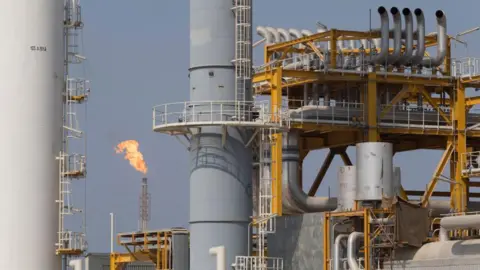
Energy Prices Skyrocket Amid Supply Fears
Wholesale gas prices in the UK and Europe surged by approximately 25% in early trading before a slight easing. European gas prices are now more than double the levels observed prior to the onset of the US-Israeli conflict with Iran. In the UK, gas prices are currently up around 25%, reaching approximately 175p per therm.
Oil markets also saw significant upward movement, with Brent crude briefly jumping 10% to over $119 a barrel before retreating slightly. The sudden price hikes reflect deep market anxiety over the stability of global energy supplies.
Escalation in the Middle East
The price surge follows an attack on Iran's South Pars gas facility, one of the world's largest natural gas fields, on Wednesday evening. Iran retaliated swiftly, targeting a major liquefied natural gas (LNG) export facility in Qatar, Ras Laffan, which reportedly sustained "extensive damage." These events raise serious questions about the security of critical energy infrastructure in the region.
The escalation in the Middle East underscores the region's critical role in global energy supply, with disruptions quickly rippling through international markets and impacting consumer costs. Olley News analysis suggests a prolonged conflict could significantly reshape global energy dynamics.
Global Market Reaction and Expert Warnings
The latest developments have sent shockwaves through international stock markets. In Japan, the Nikkei share index closed down 3.4%, while London's FTSE 100 experienced a 1.7% decline on Thursday morning. Investors are increasingly concerned about the potential economic impact of a prolonged conflict.
Matthieu Favas, commodities editor at The Economist, described the rise in gas prices as "huge," linking it directly to the attack on Qatar's gas facility. He warned that the damage could lead to "long-lasting disruption," potentially for months, affecting facilities that supply a fifth of the global liquid natural gas. Nick Butler, former head of strategy at BP, echoed these concerns, stating the strike on Ras Laffan "will almost certainly cut off a level of supply of LNG to the world market" that "can't be substituted very quickly at all."
Iran's Warning and Regional Responses
Iran's military had previously warned of "decisive action" in response to any attacks on its energy infrastructure. A statement published by Tasnim, a news agency affiliated with the Islamic Revolutionary Guard Corps, declared that targeting the energy infrastructure of "countries of origin" would be considered legitimate retaliation.
Qatar, which also operates facilities on the gas field (known as North Dome) and produces a fifth of the world's LNG, had already halted production earlier in March due to the ongoing conflict. Qatar's interior ministry confirmed that it had initially brought the fire at Ras Laffan under control, with no injuries reported.
US Response and Other Energy Shifts
In response to the rising oil prices, the White House announced a 60-day waiver of the Jones Act, a 1920 law typically requiring American-made ships for transport between US ports. US Press Secretary Karoline Leavitt stated this waiver aims to allow "vital resources like oil, natural gas, fertiliser, and coal to flow freely." However, maritime groups in the US have downplayed the potential impact, arguing that oil prices, rather than shipping costs, are the primary driver of rising pump prices.
Separately, Iran has also suspended the flow of gas to Iraq to bolster its domestic supplies, according to a senior Iraqi official. Data from the Gas Exporting Countries Forum indicates that 94% of Iran's gas supply is typically used domestically.
Key Takeaways
- Oil and gas prices have surged significantly after strikes on energy facilities in Iran and Qatar.
- Gas prices in the UK and Europe jumped by approximately 25%; Brent crude briefly rose 10%.
- Iran's South Pars gas field and Qatar's Ras Laffan LNG export facility were hit, with Ras Laffan sustaining "extensive damage."
- Experts warn of potential "long-lasting disruption" to a fifth of global LNG supply.
- Global stock markets, including Japan's Nikkei and London's FTSE 100, reacted negatively.
- Iran's military has issued strong warnings of retaliation for attacks on its infrastructure.
- The US has temporarily suspended the Jones Act to facilitate the flow of energy resources.


0 Comments