
BlackRock CEO Warns of Global Recession if Oil Hits $150 Amid Middle East Tensions
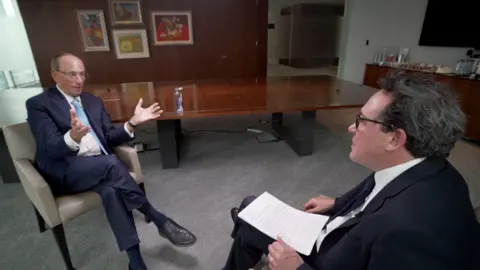
Larry Fink, CEO of financial giant BlackRock, has issued a stark warning that global oil prices soaring to $150 a barrel could trigger a worldwide recession, directly linking the threat to ongoing instability in the Middle East. Speaking in an exclusive interview, Fink also addressed the future of AI and refuted comparisons to the 2008 financial crisis.
Oil Prices and the Threat of Recession
Fink stated that if Iran "remains a threat," the world could face "years of above $100, closer to $150 oil," an outcome he believes would lead to a "probably stark and steep recession." This dire prediction underscores the profound implications of geopolitical tensions on the global economy.
He outlined two extreme scenarios for the Middle East conflict: a resolution that could see oil prices fall below pre-war levels, or a prolonged threat pushing prices towards the $150 mark. Such a surge in energy costs would have significant and regressive impacts, disproportionately affecting the poor.
The Global Energy Imperative
Amid rising energy concerns, Fink emphasized the need for countries to adopt pragmatic energy mixes, utilizing all available sources to ensure cheap energy, which he sees as crucial for driving growth and raising living standards. He described rising energy prices as a "very regressive tax."
Fink suggested that a sustained period of $150 oil for several years would rapidly accelerate global investment in alternative energy sources like solar and wind power. He advocates for countries to use their existing resources while aggressively transitioning to renewables, rather than depending on a single energy source.
BlackRock, the world's largest asset manager, controls an astounding $14 trillion in assets and holds significant stakes in countless global corporations. This immense reach grants CEO Larry Fink unparalleled insight into the pulse of the global economy, making his pronouncements closely watched by markets worldwide.
Dispelling 2008 Financial Crisis Parallels
Despite some analysts drawing parallels between current market conditions and the lead-up to the 2007-08 financial crisis, Fink was adamant that there are "zero similarities." He assured that financial institutions today are more secure and resilient, unlike the systemic vulnerabilities present during the previous crisis.
Fink acknowledged that some private credit funds have seen limited withdrawals by investors, but he characterized these issues as accounting for a small fraction of the overall market, with institutional investment remaining robust.
AI: No Bubble, but an Energy Challenge
Challenging suggestions of an "AI bubble" forming due to massive investments, Fink expressed confidence in the technology's long-term potential. BlackRock itself has made significant investments, including a $40 billion deal for Aligned Data Centres, viewing AI development as critical for technological dominance against competitors like China.
However, he highlighted the high cost of energy as a significant barrier to AI expansion in the US and Europe. Fink noted China's substantial investment in solar and nuclear power, contrasting it with what he perceives as a lack of action in Europe and the need for the US to prioritize cheap, inexpensive power for AI infrastructure.
AI's Impact on Jobs and Education
While his recent letter to shareholders touched on AI's potential to widen inequality, Fink clarified that AI would create an "enormous amount of jobs," particularly in skilled trades such as electricians, welders, and plumbers. He suggested a societal re-evaluation of career paths.
Fink called for a rebalancing of education systems, arguing that the post-World War Two emphasis on university degrees in the US might have been "overdone." He advocates for recognizing the value and strength of careers in skilled trades, stressing the importance of technical training alongside higher education.
Key Takeaways
- BlackRock CEO Larry Fink warns that oil prices hitting $150 a barrel could trigger a global recession if Iran remains a threat.
- He predicts "years of above $100, closer to $150 oil" with "profound implications" for the world economy.
- Fink urges countries to be pragmatic about their energy mix, using all sources while aggressively moving towards alternatives to ensure cheap energy.
- He strongly denies any similarities between current market conditions and the 2007-08 financial crisis, citing more secure financial institutions.
- Fink believes there is no "AI bubble" and sees AI investment as mandatory for technological dominance, but highlights high energy costs as a significant barrier.
- AI is expected to create "enormous" jobs in skilled trades, prompting a call for rebalancing education towards technical training rather than solely university degrees.


0 Comments