
Australia Secures Landmark A$10 Billion Trade Deal with European Union
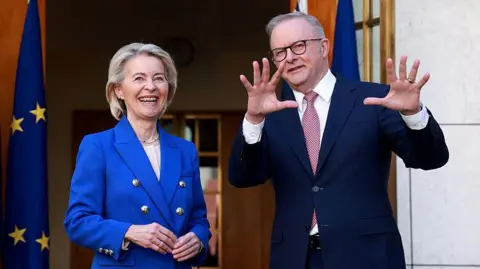
Australia has finalized a significant free trade agreement with the European Union, a deal valued at approximately A$10 billion ($7 billion; £5.2 billion), which will see a substantial reduction in export tariffs for Australian products entering Europe. The agreement, eight years in the making, was officially signed on Tuesday by Australian Prime Minister Anthony Albanese and European Commission President Ursula von der Leyen, who both hailed it as a mutual "win-win."
Broad Tariff Cuts to Boost Australian Exports
Under the newly inked agreement, nearly all EU tariffs on a wide range of Australian agricultural goods, including wine, fruit, vegetables, olive oil, seafood, most dairy products, wheat, and barley, will be lifted. The Australian government projects this will save local wine producers and exporters around A$37 million annually.
Conversely, Australian consumers can anticipate a reduction in prices for European imports such as wine, spirits, biscuits, chocolates, and pasta, fostering a mutual "win-win" scenario as described by leaders.
Navigating Geographical Indications: Prosecco and Feta
A key aspect of the deal addresses the contentious issue of food naming rights, particularly geographical indications. Australian-made Italian-style sparkling wine can continue to be sold as prosecco domestically, though the name will be phased out for exports over a decade. Australia is now the only country outside Italy permitted by the EU to use the name for domestic sales.
Similarly, Australian producers can still use names like parmesan. However, feta will be subject to "grandfathering and lengthy phase-out periods" due to stringent EU regulations. Prime Minister Anthony Albanese acknowledged the cultural significance, noting Australia's modern history built on diverse migrant communities and their culinary traditions, connecting them with European heritage.
Beef Export Quotas Fall Short of Industry Expectations
Despite overall tariff reductions, the deal has drawn criticism from Australia's red meat sector. Andrew McDonald from Meat and Livestock Australia expressed strong disappointment, stating the agreement represents a "missed opportunity" for producers, processors, and exporters. Farmers had sought an annual quota of at least 50,000 tonnes for beef exports, but the finalized deal allows for approximately 30,000 tonnes, an increase from the previous 3,389 tonnes.
Expanding Beyond Trade: Security and Critical Minerals
Beyond commerce, the agreement signifies a deeper "unique relationship" between Australia and the EU, built for the long term. A new security and defence partnership will enhance cooperation in areas such as defence industry, counter-terrorism, space, and maritime security, focusing on "collective resilience" in a changing global landscape.
European Commission President Ursula von der Leyen highlighted further cooperation on critical minerals projects, including lithium and tungsten. She also commended Australia's "trailblazing" social media policy that prohibits under-16s from holding accounts on ten major platforms, emphasizing that "trust matters more than transactions" in a world where great powers use tariffs and supply chains as leverage.
Key Takeaways
- The trade deal is valued at approximately A$10 billion, cutting most EU tariffs on Australian agricultural products.
- Australian wine and produce will see significant tariff reductions, projected to save exporters A$37 million annually.
- Controversial food naming rights: Australian prosecco allowed domestically, parmesan use continues, but feta faces lengthy phase-out periods for exports.
- Australian beef exports secured a quota of about 30,000 tonnes, which is significantly less than the 50,000 tonnes requested by industry.
- The agreement also includes new partnerships in security, defence, counter-terrorism, and critical minerals cooperation.
This landmark agreement underscores the evolving geopolitical landscape, where trade deals are increasingly intertwined with broader strategic alliances, focusing on supply chain resilience and security cooperation in addition to economic benefits.


0 Comments